

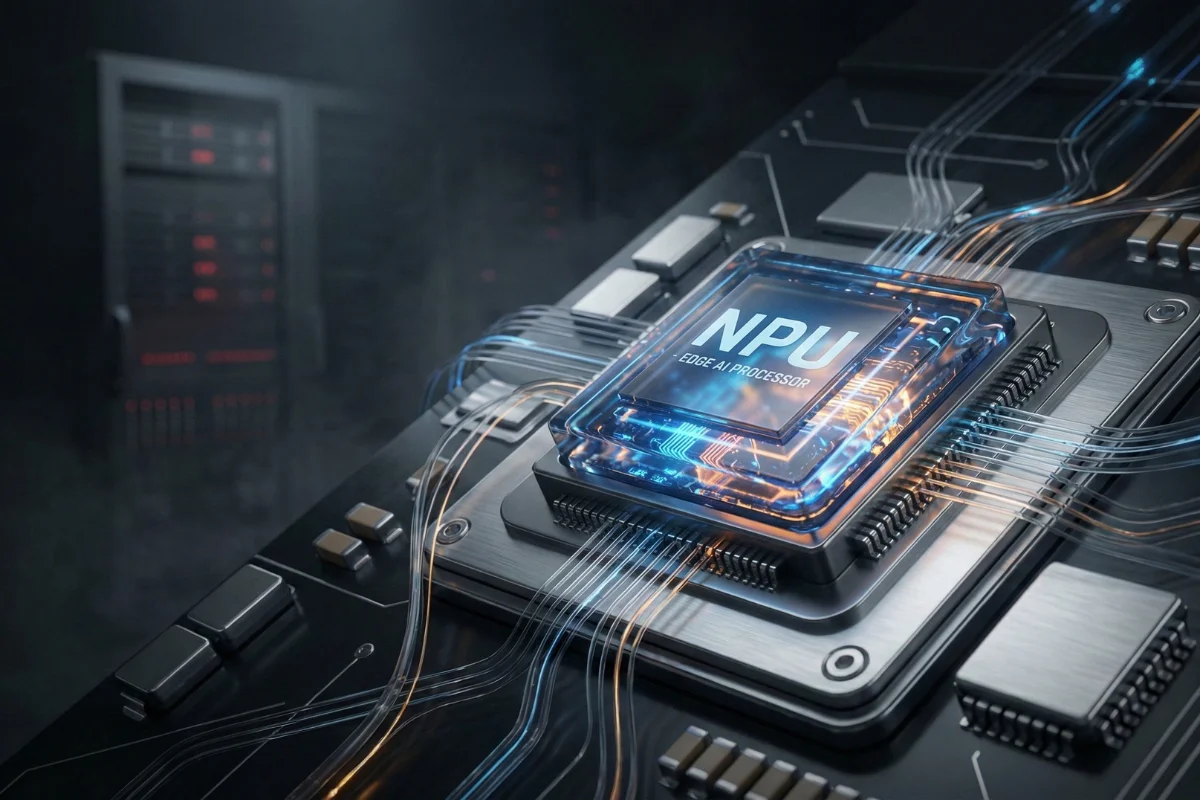
The era of defaulting to massive data centers is fracturing. For engineers, investors, and founders tracking the hottest edge ai startups 2026, the operational focus has violently shifted from cloud dependencies to localized, instantaneous intelligence. We are witnessing a fundamental architectural rewrite of how machines process physical reality.
Over the last three years, enterprises bled capital scaling cloud-bound large language models. Latency bottlenecks paralyzed autonomous features, while skyrocketing bandwidth costs suffocated industrial Internet of Things (IoT) deployments. Now, computing power migrates directly to the source, exactly where the data originates.
This technical briefing decodes the momentum driving this decentralized infrastructure shift. You will learn why local inference wins the unit economics battle, which specialized hardware innovations dominate the market, and how to position your technical stack for the next massive wave of autonomous networks.
Crushing Cloud Costs: The Financial Engine Behind Local AI
The artificial intelligence inference market demands split-second responses that fiber optics simply cannot guarantee. Cloud round-trips consistently take hundreds of milliseconds, creating unacceptable bottlenecks for critical enterprise applications. In autonomous manufacturing or robotic surgery, that microscopic delay proves catastrophic.
Pioneering builders bypass these physical network limitations entirely. They deploy highly optimized, localized models directly onto embedded hardware arrays and computer vision sensors. This architecture completely eliminates the requirement to pipe terabytes of raw, unfiltered data back to centralized server farms.
Founders must recognize that the baseline unit economics of machine learning have permanently changed. Running a massive parameter model in the cloud burns operational cash rapidly. Conversely, executing quantized, task-specific models on edge nodes drastically cuts recurring cloud compute expenditures.
Optimize for Data Privacy and Compliance
Sending sensitive proprietary information across public internet channels introduces severe vulnerability vectors. Industries like healthcare and defense require absolute data sovereignty. Edge computing solves this by processing diagnostic information locally, ensuring that raw patient data never leaves the physical facility.
This decentralized approach instantly neutralizes complex HIPAA compliance hurdles for medical startups. Companies can extract clinical insights immediately while maintaining strict cryptographic boundaries. The network only transmits anonymized, finalized metadata back to the central repository.
Following the Capital: Why edge ai startups 2026 Dominate VC Deal Flow
Venture capital markets aggressively adjusted their thesis away from generic software wrappers toward deep-tech hardware infrastructure. Specialized silicon and localized intelligence now capture the largest share of early-stage funding. The global edge AI market projects a 21.7% compound annual growth rate, rapidly approaching $118 billion.
Heavyweight investors like NVIDIA, Intel Capital, and Qualcomm Ventures poured over $1.4 billion into edge AI chip manufacturers recently. They recognize that software cannot evolve faster than the physical hardware housing it. These strategic investments target companies building Neural Processing Units (NPUs) that operate on microscopic power budgets.
The embodied AI and robotics sector also commands massive capital pools, securing nearly $2.9 billion across key startup deals. Startups building humanoid robots require extreme edge processing to navigate dynamic physical environments without dropping network packets.
Deploy Actionable Hybrid Architectures
Do not abandon the cloud entirely; redefine its purpose in your engineering stack. Smart technical teams use the cloud exclusively for asynchronous model training and global fleet management. They push the actual real-time inference workloads directly down to the edge devices.
This hybrid topology delivers the absolute best of both computing paradigms. You maintain the massive compute power required to refine complex neural networks globally. Simultaneously, you guarantee zero-latency execution for the end-user locally.
The Tech Stack: Engineering High-Performance Local AI
Deploying intelligent systems outside a climate-controlled data center requires ruthless software optimization. Hardware must survive extreme temperatures, physical vibration, and strict wattage constraints. Software must shrink dramatically without triggering catastrophic accuracy loss.
Leading engineering teams utilize aggressive model quantization to compress massive neural networks. They convert standard 32-bit floating-point parameters into highly efficient 8-bit or 4-bit integers. This drastically reduces memory bandwidth requirements while instantly accelerating inference speed on embedded systems.
Federated learning represents another critical breakthrough for decentralized startup networks. Edge devices train collaboratively using local data and share only the calculated mathematical model updates, not the raw datasets. This creates continuously improving global intelligence without ever centralizing sensitive user information.
⚙️ The Core Infrastructure Showdown
| ⚙️ Architecture Feature | ☁️ Cloud-Bound AI | ⚡ Edge AI Startups |
|---|---|---|
| ⏱️ Latency | High (100ms – 500ms+) | Ultra-Low (<10ms) |
| 💰 Inference Cost | Expensive (Recurring API/Cloud fees) | Highly Efficient (One-time hardware + low power) |
| 🔒 Data Privacy | Vulnerable (Data travels across networks) | Secure (Data remains strictly on-device) |
| 📊 Bandwidth Needs | Massive (Continuous streaming required) | Minimal (Only lightweight metadata transmitted) |
| 🌐 Offline Capability | ❌ Impossible | ✅ Fully Functional |
Industry Disruption: Where Local Intelligence Wins Today
The theoretical, experimental phase of edge computing is officially dead; we are now fully in the execution era. Specific industry verticals actively use on-device intelligence to fundamentally alter their operational profit margins.
Manufacturing and Industrial IoT
Factory floors utilize embedded computer vision for instantaneous quality control. Edge-based predictive maintenance systems detect microscopic acoustic anomalies in heavy machinery. CTOs report that this localized intelligence reduces unplanned operational downtime by up to 40%.
Autonomous Vehicles and Robotics
Modern autonomous systems act as rolling supercomputers, generating massive terabytes of sensor data daily. Relying on 5G networks for split-second braking decisions is engineering malpractice. Edge nodes process LIDAR and radar data locally to ensure life-saving, instantaneous reactions.
Neuromorphic Silicon: The Visionary Hardware Frontier
Traditional von Neumann architectures separate memory and processing, creating inherent speed limitations. To truly unlock local intelligence, hardware engineers are radically redesigning silicon to mimic human neural pathways. This represents the absolute bleeding edge of hardware innovation.
Neuromorphic chips process information using highly efficient artificial synapses. They only consume significant power when an actual event triggers a computation. This event-driven architecture allows remote edge devices to remain in deep sleep modes while continuously monitoring their environment.
When an anomaly occurs, the chip wakes instantly, processes the data, and returns to sleep. This breakthrough allows complex neural networks to run on simple battery power for years. The edge ai startups 2026 pioneering this specialized silicon will completely monopolize the next generation of embedded hardware.
Deploying Your Edge Strategy: The Execution Checklist
Transitioning to localized artificial intelligence requires a deliberate, hardware-first engineering approach. Focus on these critical integration points to ensure your deployment succeeds in the real world:
- ✅ Audit Power Constraints: Measure the exact wattage available at your physical deployment site before selecting an NPU.
- ✅ Implement Fleet Management: Build robust OTA (Over-The-Air) pipeline systems to silently update models across thousands of distributed edge devices.
- ✅ Test Environmental Tolerance: Ensure your hardware safely handles thermal throttling under continuous, heavy inference loads.
- ❌ Avoid Monolithic Models: Never attempt to force a massive, unoptimized transformer onto a constrained edge node.
- ❌ Stop Hoarding Raw Data: Configure your telemetry to only transmit anomalies or extreme edge cases back to the cloud for retraining.
Conclusion
The future of machine learning does not live in a centralized, hyperscale data center. It lives on the factory floor, inside the autonomous vehicle, and on the microscopic sensors monitoring our physical world. The founders and engineers mastering this localized intelligence will define the next decade of digital infrastructure.
Do not wait for recurring cloud costs to suffocate your startup margins. Start benchmarking quantized models on embedded hardware today, and aggressively transition your latency-sensitive workloads to the edge.
Further Reading
- GPT 5.2 Limits USA: Did OpenAI Just Quietly Cap Your Workflow? [2026 Alert]
![GPT 5.2 Limits USA: Did OpenAI Just Quietly Cap Your Workflow? [2026 Alert]](https://newaidaily.com/wp-content/uploads/2026/02/news-150x150.webp)
- Claude Sonnet 4.6 Pricing: The 2026 Enterprise ROI Guide

- AI Deepfake Scam Protection 2026: Stop Voice Clones

- AI Tools Pricing 2026: Build Your Lean Solo Stack for Under $50/Month

- OpenAI Paywall Panic: The Best Sora Free Alternative

![GPT 5.2 Limits USA: Did OpenAI Just Quietly Cap Your Workflow? [2026 Alert]](https://newaidaily.com/wp-content/uploads/2026/02/news.webp)



![Master Data Fast: Advanced Copilot Excel Prompts [2026 Guide]](https://newaidaily.com/wp-content/uploads/2026/02/Copilot-no-Excel.webp)